
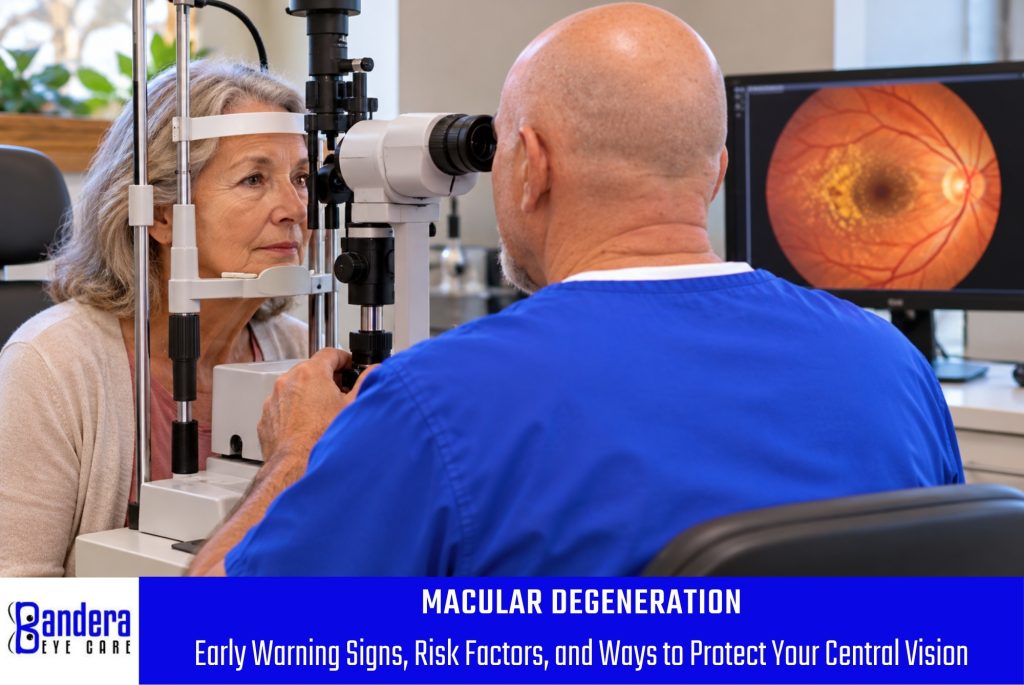
Reading, recognizing faces, driving, and seeing fine details all depend on healthy central vision.
Age-related macular degeneration, commonly called AMD, affects the macula, a small but essential part of the retina responsible for detailed central eyesight.
AMD is a leading cause of significant vision impairment among older adults. Although it does not typically cause complete blindness, advanced disease can make many everyday activities difficult.
At Bandera Eye Care in Bandera, TX, understanding macular degeneration can help patients recognize symptoms, identify risk factors, and seek appropriate monitoring.
What Is Age-Related Macular Degeneration?
AMD is a retinal condition involving progressive changes in the macula.
The macula provides the sharp central vision needed for reading, recognizing faces, and performing detailed tasks.
How AMD Affects Vision
Patients may experience blurred central vision, distortion, or difficulty seeing fine details.
Peripheral vision is usually preserved, even in advanced disease.
What Are the Different Types of Macular Degeneration?
Dry Age-Related Macular Degeneration
Dry AMD is the more common form.
It involves changes such as drusen deposits and degeneration of retinal tissues.
Early disease may produce no symptoms.
Geographic Atrophy
Geographic atrophy is an advanced form of dry AMD involving loss of retinal cells.
It can cause progressively enlarging areas of central visual impairment.
Wet Age-Related Macular Degeneration
Wet AMD develops when abnormal blood vessels grow beneath the retina and leak fluid or blood.
It can cause rapid deterioration of central vision.
Prompt treatment is important.
What Are the Early Warning Signs of Macular Degeneration?
Blurry Central Vision
Words or faces may become less distinct.
Distorted Straight Lines
Door frames, window blinds, or printed lines may appear wavy or bent.
Difficulty Recognizing Faces
Central visual changes can interfere with facial recognition.
Dark or Missing Areas in Central Vision
Advanced disease may produce blind spots near the center of the visual field.
Difficulty Seeing in Low Light
Some patients notice increasing difficulty adapting to dim environments.
Who Is at Risk for Macular Degeneration?
Increasing Age
AMD becomes more common after age 50.
Family History
Genetic factors contribute significantly to disease risk.
Smoking
Smoking is an important modifiable risk factor.
Cardiovascular Risk Factors
Hypertension and other vascular conditions may be associated with increased risk.
Lifestyle and Nutrition
Dietary patterns and overall cardiovascular health may influence risk and disease progression.
How Is Macular Degeneration Diagnosed?
Dilated Retinal Examination
Allows evaluation of the macula and surrounding retinal structures.
Optical Coherence Tomography
OCT can identify retinal fluid, tissue changes, and other structural abnormalities.
Retinal Imaging
Photographs and other imaging techniques may help document disease progression.
Amsler Grid Testing
An Amsler grid can help patients monitor certain central vision changes at home.
Home monitoring does not replace professional retinal examinations.
What Treatments Are Available for Macular Degeneration?
Monitoring Early AMD
Early disease may require regular examinations and risk-factor management.
AREDS2 Supplements
Certain patients with intermediate AMD or advanced AMD in one eye may benefit from AREDS2-formulation supplements.
These supplements are not recommended for everyone and do not prevent AMD in people without the appropriate disease stage.
Anti-VEGF Injections
Wet AMD is commonly treated with medications injected into the eye to reduce abnormal blood vessel activity.
Treatments for Geographic Atrophy
Selected patients with geographic atrophy may be candidates for therapies intended to slow lesion progression.
These treatments have limitations and potential risks and require specialist assessment.
How Can You Reduce Your Risk of Vision Loss?
Avoid smoking, manage cardiovascular risk factors, maintain appropriate nutrition, and attend recommended eye examinations.
Patients diagnosed with AMD should follow individualized monitoring and treatment recommendations.
Frequently Asked Questions About Macular Degeneration
What Is the First Sign of Macular Degeneration?
Early AMD often has no symptoms. Later signs may include blurred central vision or distortion of straight lines.
Can Macular Degeneration Cause Blindness?
Advanced AMD can cause severe central vision loss, although peripheral vision is usually preserved.
Is Macular Degeneration Hereditary?
Genetics contribute to risk, but family history does not guarantee that someone will develop AMD.
Can Macular Degeneration Be Cured?
There is currently no cure. Certain treatments can slow progression or preserve vision, depending on disease type and stage.
Are Eye Vitamins Helpful for Everyone?
No. AREDS2 supplements are intended for specific categories of AMD risk and should be discussed with an eye care professional.
Can Wet Macular Degeneration Develop Suddenly?
Wet AMD can cause rapid changes in central vision and requires urgent retinal evaluation.
Does Macular Degeneration Affect Both Eyes?
It can affect one or both eyes, sometimes with different severity.
How Often Should Someone With AMD Have Eye Exams?
The appropriate schedule depends on disease stage, symptoms, and treatment requirements.
Contact Information
If you notice changes in central vision, distorted lines, or difficulty recognizing faces, prompt evaluation is important.
Bandera Eye Care 1136 Main Street Bandera, TX 78003 Phone: (830) 850-0628 Website: banderaeyecare.com
CLICK HERE TO BOOK AN APPOINTMENT
New distortion or sudden central vision loss requires urgent assessment rather than a routine appointment.