
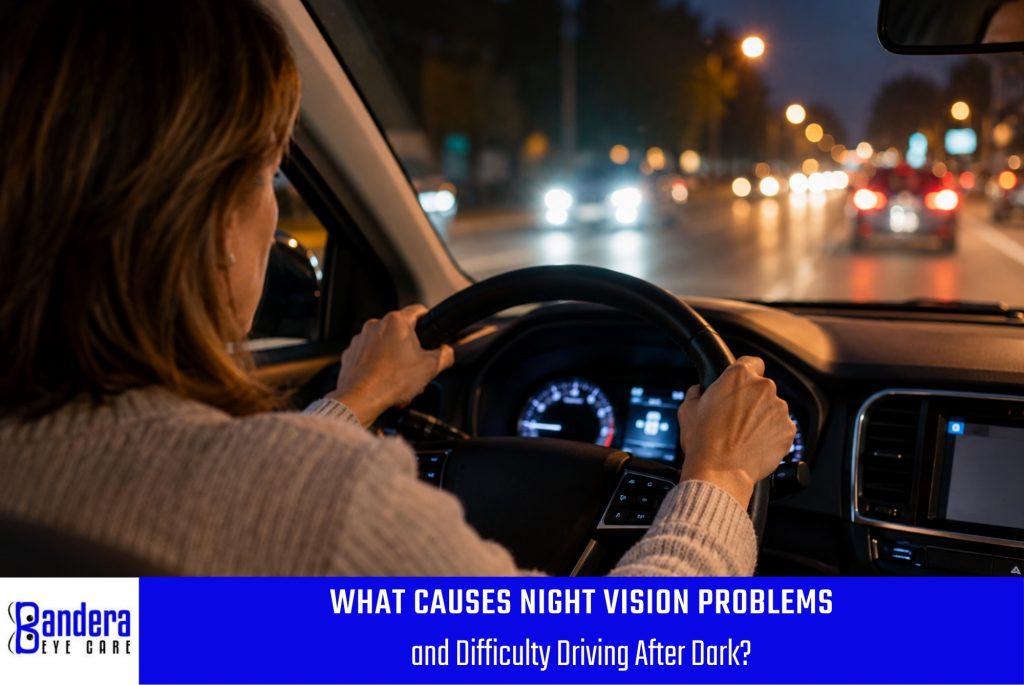
Driving after sunset can become challenging when headlights appear unusually bright, road signs are difficult to read, or surrounding objects seem less defined.
Although some changes in low-light vision occur naturally with age, increasing difficulty driving at night may indicate a refractive error, cataracts, dry eye disease, or another eye condition.
For residents of Bandera and surrounding Texas Hill Country communities, clear nighttime vision is especially important when traveling along rural roads with limited street lighting.
Bandera Eye Care encourages patients experiencing changes in nighttime vision to seek a comprehensive eye examination.
Why Is Vision Different at Night?
Vision depends on specialized cells in the retina called rods and cones.
Cone cells support detailed and color vision in brighter conditions. Rod cells are more sensitive to low levels of light and play an important role in nighttime vision.
Pupil Dilation in Low Light
In darker environments, the pupils enlarge to allow more light into the eyes.
Larger pupils may expose optical imperfections that are less noticeable during daylight.
Reduced Contrast Sensitivity
Contrast sensitivity is the ability to distinguish objects from their backgrounds.
Reduced contrast sensitivity can make pedestrians, road markings, and objects along the roadside more difficult to detect.
What Eye Conditions Cause Night Vision Problems?
Cataracts
Cataracts scatter incoming light, producing glare, halos, and reduced contrast.
People with cataracts may notice that approaching headlights become increasingly uncomfortable.
Astigmatism
Astigmatism can cause lights to appear stretched, blurred, or surrounded by streaks.
These symptoms may become more noticeable when pupils enlarge at night.
Nearsightedness
Uncorrected myopia can make distant road signs, traffic signals, and objects difficult to see clearly.
Dry Eye Disease
An unstable tear film can cause fluctuating visual clarity and increased light scatter.
Glaucoma and Retinal Disease
Glaucoma and certain retinal conditions may reduce peripheral vision, contrast sensitivity, or adaptation to darkness.
Some inherited retinal disorders can cause significant night blindness.
What Are Common Symptoms of Poor Night Vision?
Patients may experience increased glare from headlights, halos around streetlights, difficulty recognizing objects in dim lighting, trouble adjusting between bright and dark environments, or reduced confidence driving after sunset.
Some people also notice that they require brighter lighting for reading and household activities.
How Are Night Vision Problems Diagnosed?
Visual Acuity and Refraction
Testing determines whether a prescription change may improve distance vision.
Cataract Evaluation
A slit-lamp examination helps identify lens clouding that may contribute to glare.
Retinal and Optic Nerve Assessment
Examination of the retina and optic nerve can help identify conditions affecting nighttime vision.
Additional Testing
Depending on symptoms, an eye doctor may recommend visual field testing, contrast sensitivity assessment, or referral for specialized retinal testing.
How Can You Improve Nighttime Driving Comfort?
Keep Your Prescription Current
Properly corrected vision is essential for safe driving.
Clean Eyeglasses and Windshields
Smudges, scratches, and dirty windshields can increase glare and scatter light.
Reduce Dashboard Brightness
Excessively bright dashboard displays can interfere with comfortable adaptation to dark surroundings.
Avoid Unnecessary Night Driving
If you cannot reliably identify road hazards, consider alternative transportation until your vision has been evaluated.
Address Underlying Eye Conditions
Treating dry eye disease, updating corrective lenses, or evaluating cataracts may improve visual function, depending on the diagnosis.
Frequently Asked Questions About Night Vision
Why Do Headlights Look So Bright at Night?
Cataracts, astigmatism, dry eyes, and other optical abnormalities can increase glare or light scatter.
Can Astigmatism Make Night Driving Difficult?
Yes. Astigmatism can blur distant objects and distort the appearance of lights.
Are Night Vision Problems a Sign of Cataracts?
They can be. Glare sensitivity and difficulty driving at night are common cataract symptoms, although other conditions may produce similar problems.
Can Glasses Improve Night Driving?
Proper prescription lenses may improve nighttime clarity when refractive errors are responsible.
Do Yellow-Tinted Night Driving Glasses Work?
Yellow-tinted lenses have not been shown to reliably improve nighttime driving performance and may reduce the amount of light reaching the eyes.
Does Night Vision Naturally Decline With Age?
Some changes in dark adaptation and light sensitivity occur with aging, but significant difficulty seeing at night should not automatically be considered normal.
Can Vitamin A Deficiency Cause Night Blindness?
Yes. Vitamin A deficiency can impair retinal function, although it is relatively uncommon in otherwise well-nourished adults in the United States.
When Should I Stop Driving at Night?
If glare, poor contrast, or blurry vision prevents you from recognizing road hazards or navigating safely, avoid nighttime driving until evaluated.
Contact Information
If driving after dark has become uncomfortable or difficult, Bandera Eye Care can help assess your visual clarity and eye health.
Bandera Eye Care 1136 Main Street Bandera, TX 78003 Phone: (830) 850-0628 Website: banderaeyecare.com