
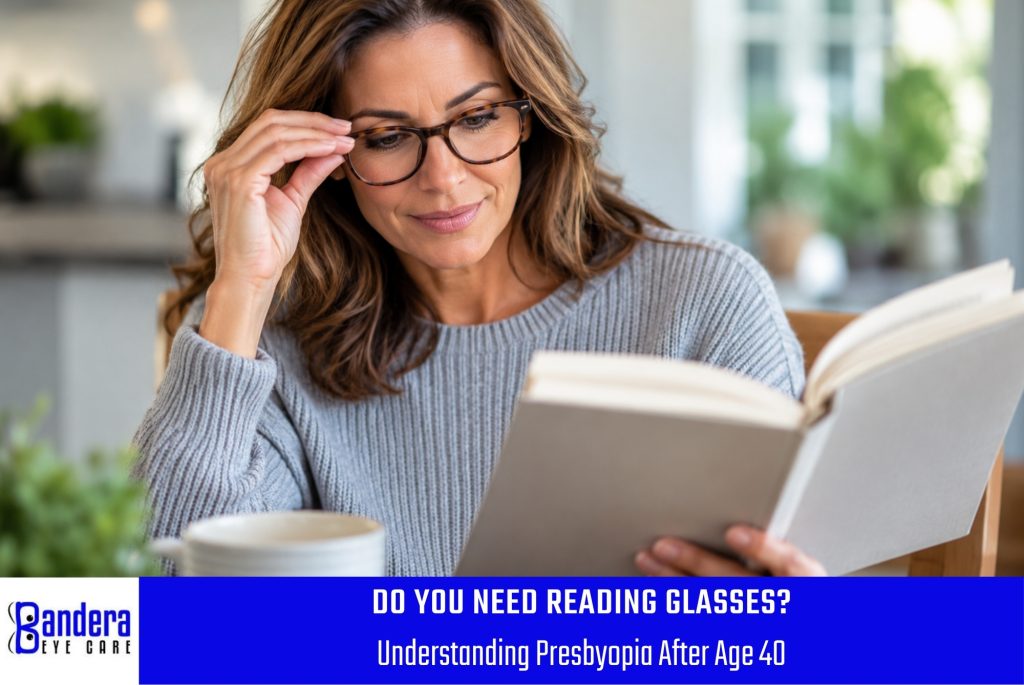
Have you started holding restaurant menus farther away to read them? Do you need brighter lighting to see small print, or find yourself removing your glasses to look at your phone?
These are common signs of presbyopia, a natural age-related change in the eye’s ability to focus on nearby objects.
Presbyopia typically becomes noticeable during the early to mid-40s and gradually progresses over time.
At Bandera Eye Care in Bandera, TX, understanding presbyopia can help patients explore comfortable, practical options for maintaining clear near vision.
What Is Presbyopia?
Presbyopia is the age-related decline in the eye’s ability to focus on nearby objects.
Inside the eye, the natural lens changes shape to focus light from objects at different distances.
This process is called accommodation.
As people age, the lens becomes less flexible, reducing its ability to change shape sufficiently for close-up focusing.
Why Does Presbyopia Develop After Age 40?
The natural lens gradually becomes stiffer throughout life.
By the early to mid-40s, many people begin noticing difficulty with tasks that require sustained near vision.
Changes in Lens Flexibility
A younger lens can change shape more readily to focus on nearby objects.
With age, this focusing ability decreases.
Reduced Accommodation
The eyes must exert more effort to focus on reading materials, phones, and other nearby objects.
Eventually, additional optical correction may become necessary.
What Are the Early Signs of Presbyopia?
Holding Reading Materials Farther Away
One of the most recognizable symptoms is extending your arms to make small print easier to see.
Difficulty Reading in Dim Lighting
Low light makes near tasks more challenging because the visual system has less light and contrast available.
Eye Strain During Close Work
Reading, sewing, and smartphone use may become uncomfortable after prolonged periods.
Headaches After Reading
Some people experience headaches associated with sustained near-focusing effort.
Blurry Vision at Normal Reading Distance
Text that once appeared clear may become difficult to focus on at a comfortable distance.
Is Presbyopia the Same as Farsightedness?
No. Although both can cause difficulty seeing nearby objects, they have different underlying mechanisms.
Farsightedness
Hyperopia is a refractive error related to the eye’s optical power and length.
It can occur at any age.
Presbyopia
Presbyopia results from age-related loss of accommodation.
A person can have presbyopia along with nearsightedness, farsightedness, or astigmatism.
What Are the Best Vision Correction Options for Presbyopia?
Over-the-Counter Reading Glasses
Nonprescription reading glasses may help people who have similar focusing needs in both eyes and no significant uncorrected astigmatism.
However, they do not replace a comprehensive eye examination.
Prescription Reading Glasses
Prescription readers can provide individualized correction for near tasks.
Progressive Lenses
Progressive lenses offer multiple focusing powers within one lens, allowing patients to see at near, intermediate, and far distances.
Bifocal Glasses
Bifocals contain separate zones for distance and near vision.
Multifocal Contact Lenses
Multifocal contact lenses are designed to provide functional vision at different distances.
Suitability depends on prescription, eye health, and visual expectations.
Monovision Contact Lenses
Monovision uses one eye primarily for distance and the other for near tasks.
Some patients adapt well, while others notice reduced depth perception or visual comfort.
Prescription Eye Drops and Surgical Options
Selected adults may be candidates for prescription presbyopia eye drops or surgical approaches.
These options have limitations and potential adverse effects, so a personalized assessment is essential.
How Do You Know What Strength Reading Glasses You Need?
The appropriate reading correction depends on age, existing prescription, preferred working distance, and visual demands.
A person who reads books at approximately 16 inches may need a different correction from someone who primarily works at a computer.
Why Stronger Is Not Always Better
Excessively strong reading glasses can make comfortable focusing distances too short.
The goal is to provide clear vision at the distance where you normally perform the task.
Can Presbyopia Be Prevented or Reversed?
Presbyopia is a natural age-related change and cannot currently be reliably prevented.
Although certain treatments can improve near vision, they do not restore the natural lens to its youthful flexibility.
Appropriate correction can help maintain comfort and visual function.
Why Is a Comprehensive Eye Examination Important After Age 40?
Not every near-vision complaint is caused by presbyopia.
Other conditions, including cataracts, dry eye disease, and refractive changes, may contribute to blurry vision.
A comprehensive examination can assess both your prescription needs and overall eye health.
Frequently Asked Questions About Presbyopia
At What Age Do Most People Need Reading Glasses?
Many adults begin noticing presbyopia between ages 40 and 45, although the timing varies.
Does Everyone Develop Presbyopia?
Presbyopia is a nearly universal age-related change in the eye’s focusing ability.
Can Presbyopia Cause Headaches?
Yes. Difficulty maintaining near focus may contribute to visual fatigue and headaches.
Will Wearing Reading Glasses Make My Eyes Weaker?
No. Reading glasses do not accelerate presbyopia or weaken the eyes.
Can I Buy Reading Glasses Without a Prescription?
Yes. Over-the-counter readers may work for some people, but an eye examination is recommended to assess overall eye health and determine whether individualized correction is needed.
Can Contact Lenses Correct Presbyopia?
Yes. Multifocal and monovision contact lens options may provide useful near and distance vision for suitable patients.
Does Presbyopia Keep Getting Worse?
Presbyopia generally progresses through middle age before stabilizing later in life.
Can Presbyopia Be Corrected Permanently?
Certain surgical procedures may reduce dependence on reading glasses, but no option perfectly restores youthful accommodation. Results, risks, and long-term expectations vary.
Is Presbyopia Related to Cataracts?
Both involve the natural lens and become more common with age, but they are different conditions. Presbyopia affects focusing flexibility, while cataracts involve lens clouding.
Should I See an Eye Doctor Before Buying Reading Glasses?
A comprehensive eye examination is recommended, especially if you have not had a recent exam or experience additional symptoms such as headaches, eye discomfort, or changes in distance vision.
Contact Information
If reading small print has become frustrating or you are noticing changes in your near vision, Bandera Eye Care can help evaluate your focusing needs and discuss suitable vision correction options.
Bandera Eye Care 1136 Main Street Bandera, TX 78003 Phone: (830) 850-0628 Website: banderaeyecare.com
CLICK HERE TO BOOK AN APPOINTMENT
Meta Title
Presbyopia & Reading Glasses After 40 | Bandera TX
Meta Description
Trouble reading small print after 40? Learn about presbyopia, reading glasses, and vision correction options at Bandera Eye Care in Bandera, TX.