
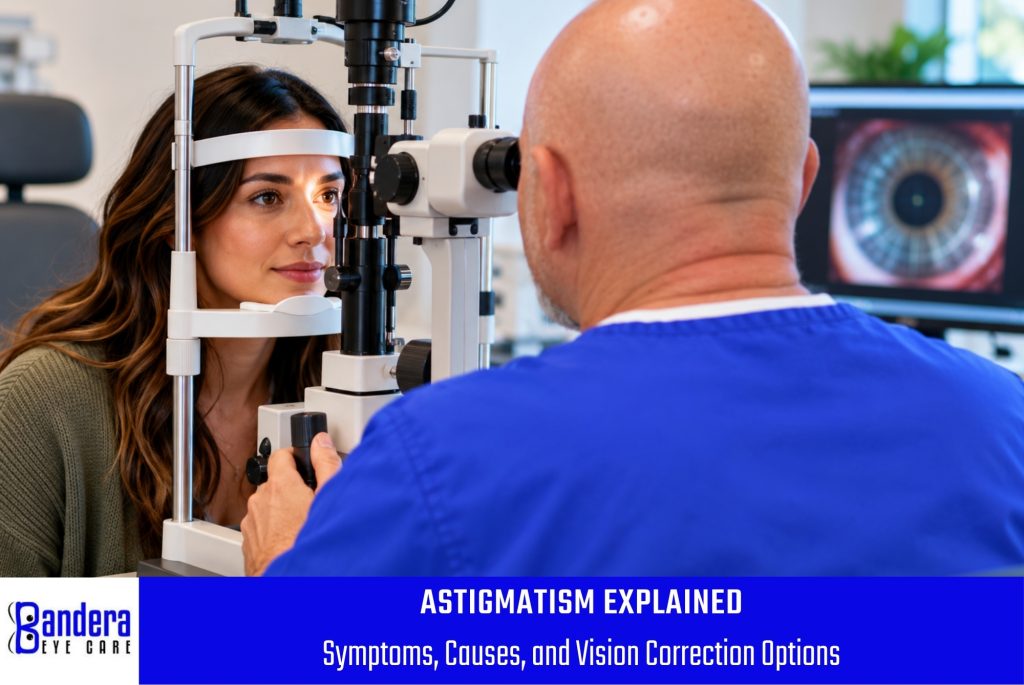
If objects appear blurry, lights seem distorted at night, or you frequently squint to see clearly, astigmatism may be contributing to your symptoms.
Astigmatism is one of the most common refractive errors and can affect people of all ages. It may occur alone or alongside nearsightedness or farsightedness.
Although the name can sound concerning, most cases of regular astigmatism can be corrected effectively with prescription glasses or contact lenses.
At Bandera Eye Care in Bandera, TX, comprehensive vision examinations can help determine whether astigmatism is affecting your eyesight.
What Is Astigmatism?
Astigmatism occurs when the cornea or internal lens has different curvatures in different meridians.
Instead of focusing incoming light at a single point, the eye focuses light differently along different orientations.
This can create blurred or distorted vision at multiple distances.
Corneal Astigmatism
Corneal astigmatism occurs when the front surface of the eye has an uneven curvature.
Lenticular Astigmatism
Lenticular astigmatism results from differences in the curvature or optical properties of the eye’s internal lens.
Both forms can affect how light focuses on the retina.
What Are the Symptoms of Astigmatism?
Blurry Vision at Multiple Distances
People with astigmatism may experience difficulty seeing clearly both near and far.
Squinting
Squinting can temporarily improve visual clarity by limiting the amount of scattered light entering the eye.
Headaches and Eye Strain
Uncorrected astigmatism may contribute to visual fatigue, particularly during prolonged reading or computer use.
Nighttime Glare
Astigmatism can cause lights to appear stretched, blurred, or surrounded by streaks.
Difficulty Reading Small Print
Letters may appear slightly distorted or less defined.
What Causes Astigmatism?
Genetics
Astigmatism often develops naturally and may run in families.
Eye Growth and Development
Changes in corneal or lens shape during development can influence refractive error.
Eye Injuries or Surgery
Certain injuries or surgical procedures can alter corneal curvature.
Corneal Conditions
Keratoconus and other corneal disorders can produce irregular astigmatism.
Unlike ordinary regular astigmatism, irregular astigmatism may require specialized evaluation and correction.
How Is Astigmatism Diagnosed?
Visual Acuity Testing
Measures how clearly a patient sees at different distances.
Refraction
Determines the lens power and cylindrical correction needed to improve vision.
Keratometry
Measures corneal curvature.
Corneal Topography
When indicated, corneal topography provides a detailed map of the corneal surface and may help identify irregularities.
What Are the Best Vision Correction Options for Astigmatism?
Prescription Eyeglasses
Glasses containing cylindrical lens correction can compensate for regular astigmatism.
They are a practical option for patients of many ages.
Toric Contact Lenses
Toric contact lenses are designed to correct astigmatism and maintain an appropriate orientation on the eye.
Rigid Gas-Permeable and Specialty Contact Lenses
Certain patients, particularly those with irregular corneal shapes, may benefit from rigid gas-permeable or scleral contact lenses.
Refractive Surgery
Procedures such as LASIK or PRK may correct certain forms of astigmatism in appropriately selected adults.
Not everyone is a candidate. Eligibility depends on corneal health, prescription stability, and other factors.
Can Astigmatism Get Worse Over Time?
Astigmatism can change throughout life.
Small prescription changes are common, but rapid progression or increasingly irregular vision may indicate an underlying corneal condition.
Changes should be evaluated rather than automatically attributed to normal aging.
Frequently Asked Questions About Astigmatism
Is Astigmatism a Disease?
No. Regular astigmatism is a refractive error rather than an eye disease.
Can You Have Astigmatism in Only One Eye?
Yes. Astigmatism may affect one or both eyes, sometimes with different severity.
Does Astigmatism Cause Blurry Vision at Night?
Yes. Astigmatism may become more noticeable in low light when the pupils enlarge.
Can Astigmatism Cause Headaches?
Uncorrected astigmatism may contribute to headaches and eye strain, particularly during sustained visual tasks.
Can Children Have Astigmatism?
Yes. Children can be born with astigmatism or develop it during childhood.
Significant uncorrected astigmatism during visual development may contribute to amblyopia.
Will Astigmatism Go Away Naturally?
Some childhood astigmatism changes as the eyes develop, but persistent astigmatism generally requires correction for optimal clarity.
Are Contact Lenses Available for Astigmatism?
Yes. Toric and specialty contact lenses can correct many types of astigmatism.
Is Astigmatism the Same as Keratoconus?
No. Astigmatism describes a focusing error, while keratoconus is a progressive corneal disorder that can cause irregular astigmatism.
Contact Information
If you experience blurry vision, frequent squinting, headaches, or difficulty seeing clearly at night, a comprehensive eye examination can help identify whether astigmatism is contributing to your symptoms.
Bandera Eye Care 1136 Main Street Bandera, TX 78003 Phone: (830) 850-0628 Website: banderaeyecare.com