
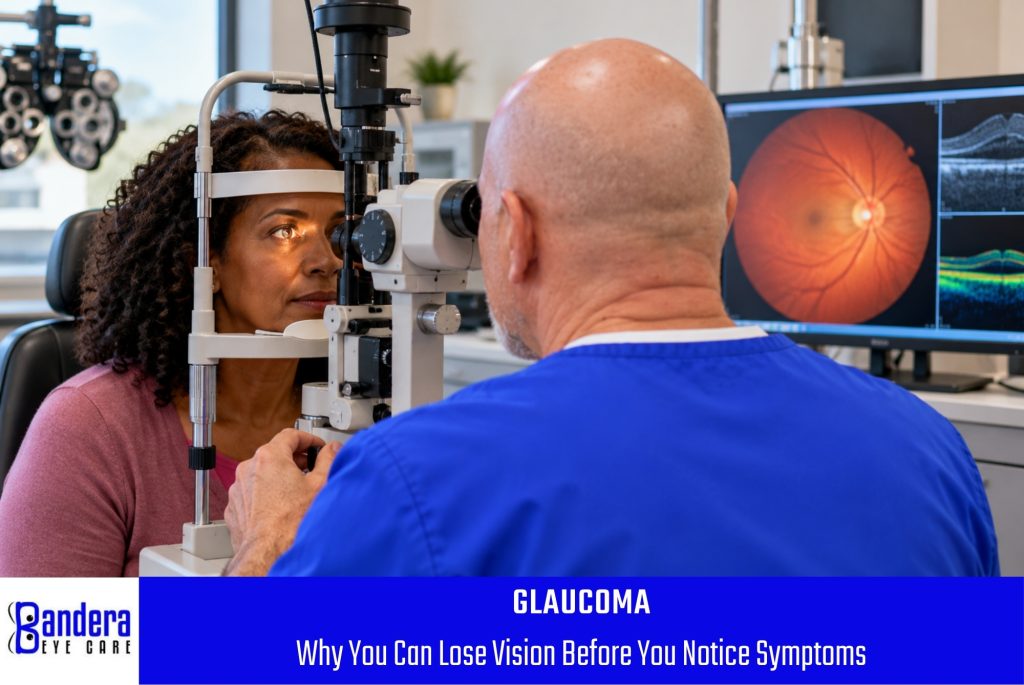
Glaucoma is one of the most important reasons to maintain regular comprehensive eye examinations, even when your vision seems perfectly normal.
This group of eye diseases damages the optic nerve, the structure responsible for transmitting visual information from the retina to the brain.
Many forms of glaucoma progress gradually and without pain. By the time noticeable vision changes develop, irreversible optic nerve damage may already have occurred.
At Bandera Eye Care in Bandera, TX, patient education and appropriate eye health evaluations play an important role in identifying glaucoma risk.
What Is Glaucoma?
Glaucoma refers to a group of disorders characterized by progressive optic nerve damage, often associated with increased pressure inside the eye.
The resulting vision loss typically begins in peripheral areas of the visual field, although patterns vary.
What Is Intraocular Pressure?
Intraocular pressure (IOP) is the pressure generated by fluid inside the eye.
The eye continuously produces and drains a fluid called aqueous humor.
When fluid drainage is insufficient relative to production, pressure may increase.
However, glaucoma can develop even when eye pressure falls within a statistically normal range.
What Are the Different Types of Glaucoma?
Primary Open-Angle Glaucoma
Open-angle glaucoma is the most common form in the United States.
It generally develops gradually as the eye’s drainage system becomes less effective or the optic nerve becomes susceptible to damage.
Early disease usually causes no noticeable symptoms.
Normal-Tension Glaucoma
Normal-tension glaucoma involves characteristic optic nerve damage despite eye pressure readings within the usual range.
This demonstrates why pressure measurement alone cannot rule out glaucoma.
Angle-Closure Glaucoma
Angle closure occurs when the drainage angle becomes obstructed.
Acute angle closure can cause severe eye pain, redness, headache, nausea, halos, and sudden blurry vision.
Acute angle-closure glaucoma is a medical emergency requiring immediate treatment.
Secondary Glaucoma
Secondary glaucoma may develop because of eye injuries, inflammation, certain medications, or other medical conditions.
Why Is Glaucoma Called the Silent Thief of Sight?
Most patients with early open-angle glaucoma do not experience pain or obvious visual changes.
Peripheral Vision Loss
Damage may initially affect areas outside central vision.
Because both eyes work together, the brain may compensate for early visual field defects.
Gradual Progression
Vision changes can occur slowly enough that patients do not recognize them.
Irreversible Optic Nerve Damage
Vision already lost from glaucoma generally cannot be restored.
Treatment focuses on slowing or preventing additional damage.
Who Is at Risk for Glaucoma?
Risk factors include increasing age, family history, elevated eye pressure, certain racial or ethnic backgrounds, significant nearsightedness, and previous eye injury.
Long-term corticosteroid use can also increase eye pressure in susceptible individuals.
Patients with additional risk factors may need closer monitoring.
How Is Glaucoma Diagnosed?
Tonometry
Measures intraocular pressure.
Optic Nerve Examination
Allows the eye doctor to evaluate the appearance of the optic nerve and look for suspicious structural changes.
Optical Coherence Tomography
OCT imaging can measure retinal nerve fiber layer and optic nerve structures.
Visual Field Testing
Measures sensitivity across the visual field and helps identify functional vision loss.
Gonioscopy
Examines the drainage angle to help classify glaucoma and assess angle-closure risk.
No single test is sufficient for every patient. Diagnosis often requires evaluating several findings together over time.
How Is Glaucoma Treated?
Prescription Eye Drops
Pressure-lowering medications can reduce aqueous humor production or improve drainage.
Laser Procedures
Selected glaucoma types may be treated with laser procedures designed to improve fluid outflow or address drainage angle problems.
Glaucoma Surgery
Surgical procedures may be recommended when medication or laser treatment does not provide adequate pressure control.
Treatment plans depend on glaucoma type, severity, risk of progression, and overall health.
Can Glaucoma Be Prevented?
There is no guaranteed method of preventing every type of glaucoma.
However, early detection and effective pressure management can substantially reduce the likelihood of progressive vision loss.
Maintaining recommended examinations is especially important for people with a family history of glaucoma.
Frequently Asked Questions About Glaucoma
Can You Have Glaucoma Without Symptoms?
Yes. Early open-angle glaucoma commonly develops without noticeable symptoms.
Can Glaucoma Cause Blindness?
Yes. Advanced untreated glaucoma can cause severe vision loss or blindness.
Is Glaucoma Hereditary?
Family history is an important risk factor, although glaucoma can occur without affected relatives.
Can You Have Glaucoma With Normal Eye Pressure?
Yes. Normal-tension glaucoma causes optic nerve damage despite pressure readings within the typical range.
Is Glaucoma Curable?
There is currently no cure for established glaucoma-related optic nerve damage. Treatment aims to preserve remaining vision.
Are Glaucoma Eye Drops Necessary for Life?
Many patients require long-term treatment, although the exact approach may change based on clinical response.
Does Glaucoma Always Affect Both Eyes?
Glaucoma can affect one or both eyes, sometimes with different severity.
How Often Should Someone With Glaucoma Have Eye Exams?
Monitoring frequency depends on disease severity, pressure control, and progression risk. Some patients require examinations several times per year.
Contact Information
Glaucoma can affect your eyesight before you recognize a problem. Bandera Eye Care encourages patients to discuss individual glaucoma risk and appropriate screening during comprehensive eye examinations.
Bandera Eye Care 1136 Main Street Bandera, TX 78003 Phone: (830) 850-0628 Website: banderaeyecare.com